Our Software Tools
Our scientific software is made available under an OSI-approved open-source Apache license.
Overview of software
This page documents the efforts expended on software engineering, some of which resulted in running software.
- Use of OpenFold was our initial emphasis, but we failed to recruit a gene folding expert to interpret output. We did not add code to OpenFold.
- Preston analyzed Python to contribute a mathematical model.
- Between January and June, most of our software attempted to use game-like interfaces to teach students about the mathematical models that we believed should apply to our experimental results. The game arcade helped acclimate the students at the start of the project.
- Jett provided animations that fall under the Creative Commons license.
- After June, Nico developed further Python/Jupyter software to predict useful directions for future research.
The PETosome AI Design Toolkit
Alongside the mathematical models above, Nico built a small AI pipeline to help diagnose and fix two problems that showed up once our fusion enzymes reached the wet lab. It combines ESM2 (a protein language model, used to score how biologically plausible a sequence is) with ESMFold (structure prediction, used to check whether a designed sequence still folds sensibly and to measure distances/pocket volumes on the predicted structure).
The two problems it addresses
1. The dockerin blocks the active site. Fusing a dockerin "hook" onto our PETase (ICCG–DoT) to attach it to the PETosome scaffold cut its activity roughly 6× on a small-molecule assay, and TPA production on real PET film dropped progressively with reaction depth (7% for BHET, 29% for MHET, 44% for TPA) — a signature of the dockerin physically crowding the enzyme's "doorway." We used ESM2 + ESMFold to design and score alternative linkers that push the dockerin further from the active site.
2. MHETase is the bottleneck. Even without any fusion, our PETase produces MHET faster than our MHETase (TfCa–DoG) can consume it: after 96 hours, 67% of product was still stuck as MHET and only 32% had reached the final product, TPA. We had already rationally designed one improved mutant (TfCaWA, carrying I69W/V376A) to widen the substrate pocket, but hadn't tested it yet or asked whether a better substitution exists. We used ESM2 to scan every pocket-lining residue for plausible substitutions, then predicted structures for the resulting candidate mutants.
Pipeline & environment
Both notebooks run in a reproducibility-pinned Conda environment (Python 3.10, PyTorch 2.12.1 + CUDA 12.1, Transformers 5.12.1, BioPython 1.87, py3Dmol for visualization), with random seeds fixed to 42 across NumPy, PyTorch, and Python's random so that results are identical across machines running the same model weights. Each notebook ranks its candidates with a composite score blending three signals: ESM2 sequence plausibility, ESMFold pLDDT (structure-confidence, >70 considered reliable), and a geometry term (active-site distance for linkers; pocket volume for mutants). The run below is the real model (ESM2–650M / ESMFold v1, on an RTX 3060 12GB), independently verified — every structure file was checked for genuine multi-atom-per-residue geometry and a fresh generation timestamp, ruling out leftover placeholder data.
These are conjectures rather than ironclad predictions
The structures and ESM2 scores below are real, verified model output — not mock data. However, we suspect the composite ranking itself is misleading for both notebooks, for different reasons. Linkers: every GS-repeat candidate actually placed the dockerin closer to the active site than the native linker (9.3–16.0 Å vs. 17.8 Å) — the opposite of what we're trying to achieve. GS_len25 only tops the composite score because of its ESM2/pLDDT terms; on the distance metric the pipeline exists to optimize, it's one of the weaker options. This may be an ESMFold artifact (it's known to render floppy glycine–serine loops as artificially compact) rather than true biology, and needs checking against a second structure predictor or the wet lab before we act on it. Mutants: the pocket free-volume term came out identical (3550.8 ų) across all four constructs — a bug, since it only counts backbone atoms in a fixed sphere and can't register a single side-chain substitution — so it contributes nothing to the ranking. Separately, the WT and TfCaWA control ESM2 scores are hardcoded constants left in the notebook, not computed values. So "WT wins" is an artifact of these two gaps, not a real finding that the wild type outperforms the engineered mutants. Bottom line: the pipeline itself now works correctly, but neither ranked table currently supports picking a construct to synthesize. See the verification report and full explainer below for the complete analysis and the concrete fixes needed (side-chain-aware pocket volume, real ESM2 scores for the controls) before the next design–build–test cycle.
Linker optimization — predicted structures
Nine candidate linkers (five rational glycine–serine repeats, four AI-guided sequences) were generated and scored; the full ranking table and comparison chart are archived on the Raw Data page. GS_len25 tops the composite score, but as the caveat above explains, its real active-site distance is actually shorter than the native linker's — so this is not yet a confident pick:
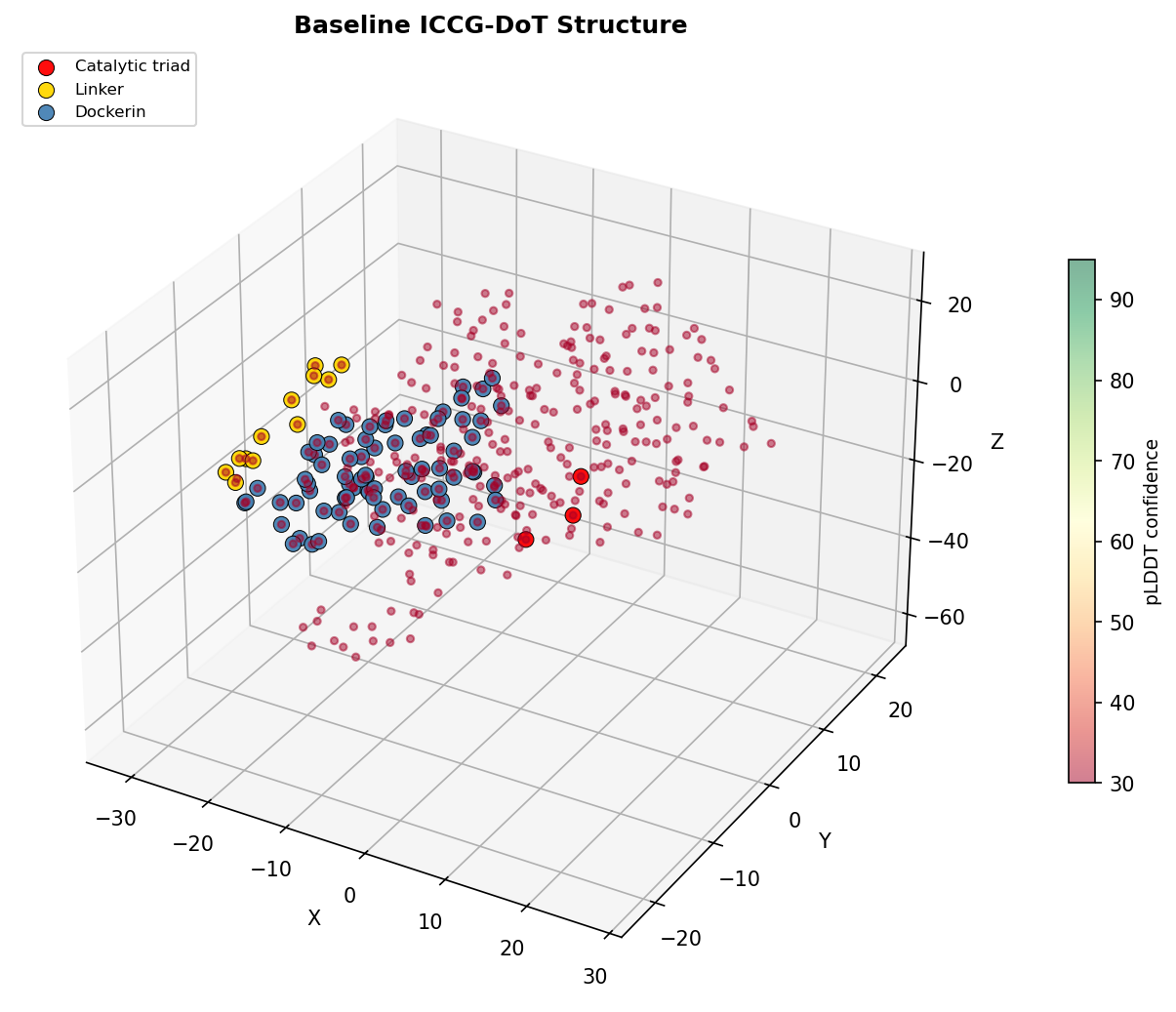
Native linker (baseline) — real distance 17.8 Å
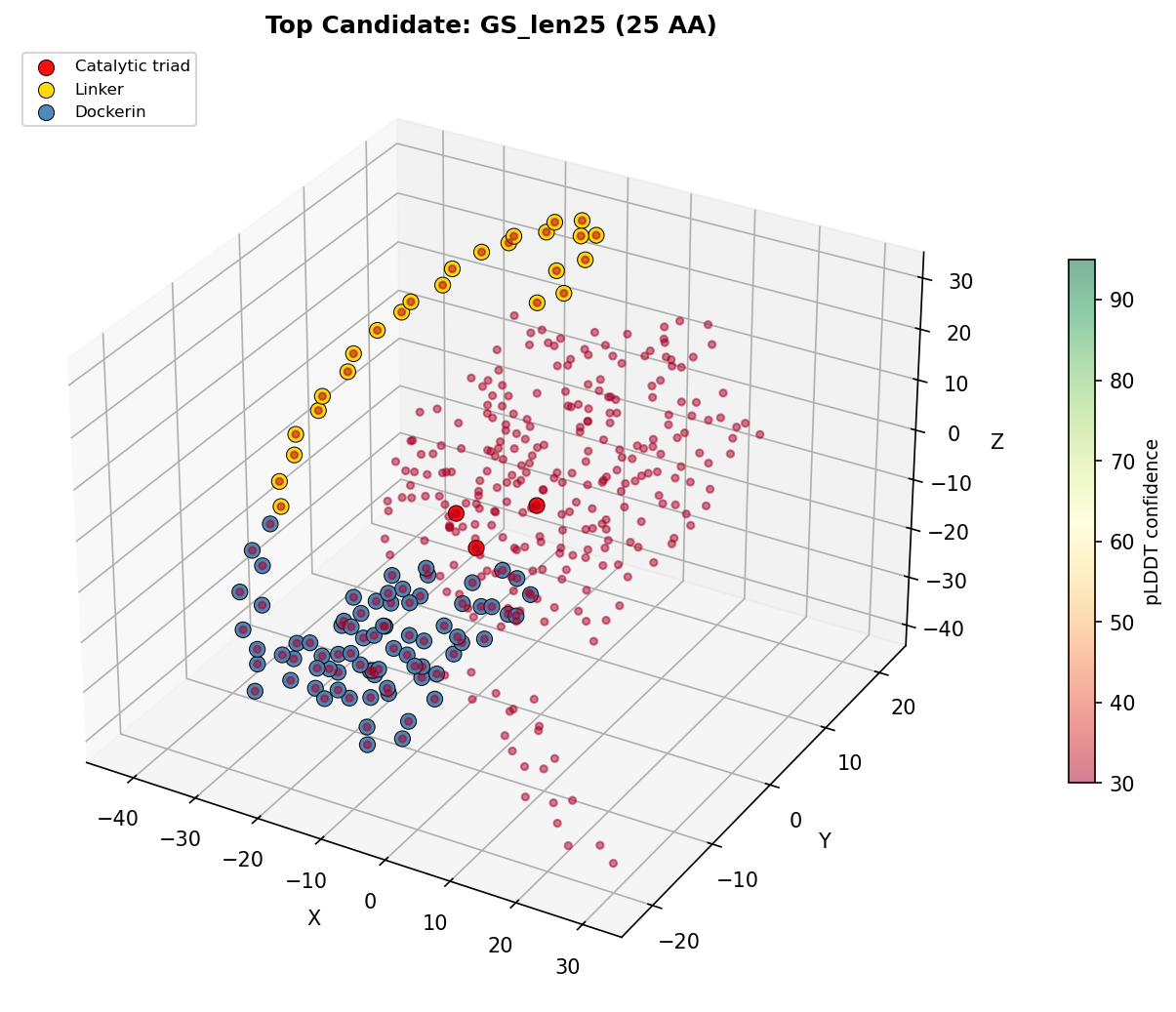
GS_len25 (top composite score) — real distance 11.2 Å
We're treating the composite ranking as provisional until the distance discrepancy is resolved; see Raw Data for the full scoring table across all four retained candidates.
MHETase pocket engineering — predicted structures
ESM2 scanned 11 residues lining the MHETase substrate-binding pocket; suggestions were combined into 8 candidate mutants (full ranking on Raw Data). Position 69 comes up as the most-suggested site to mutate — consistent with our original rational design (TfCaWA, I69W/V376A) — and ESM2 favors phenylalanine (I69F) there over the tryptophan we already picked, but as the caveat above explains, the pocket-volume metric can't currently distinguish any of these constructs, so this shouldn't be read as a ranked recommendation yet:
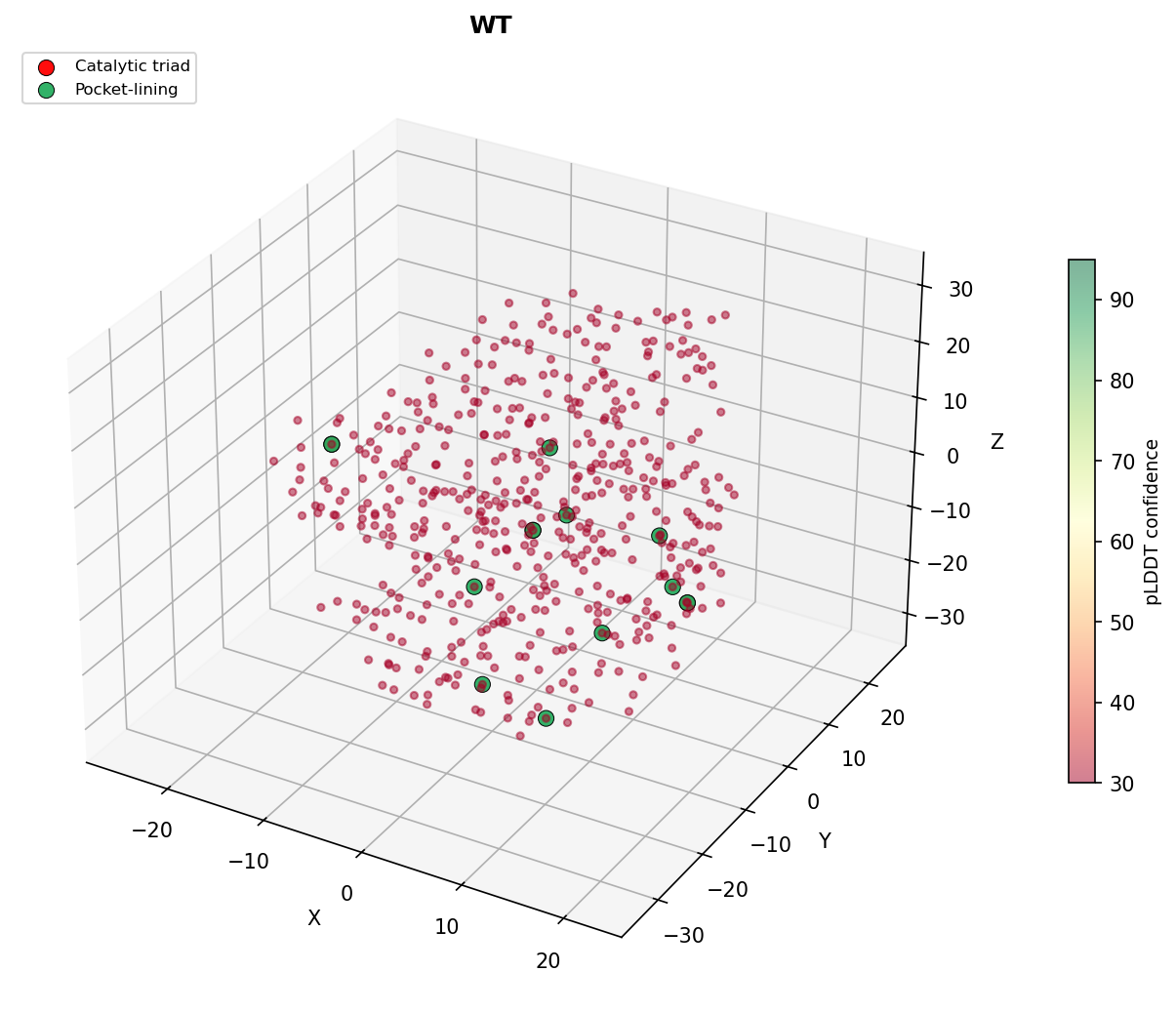
WT (native)
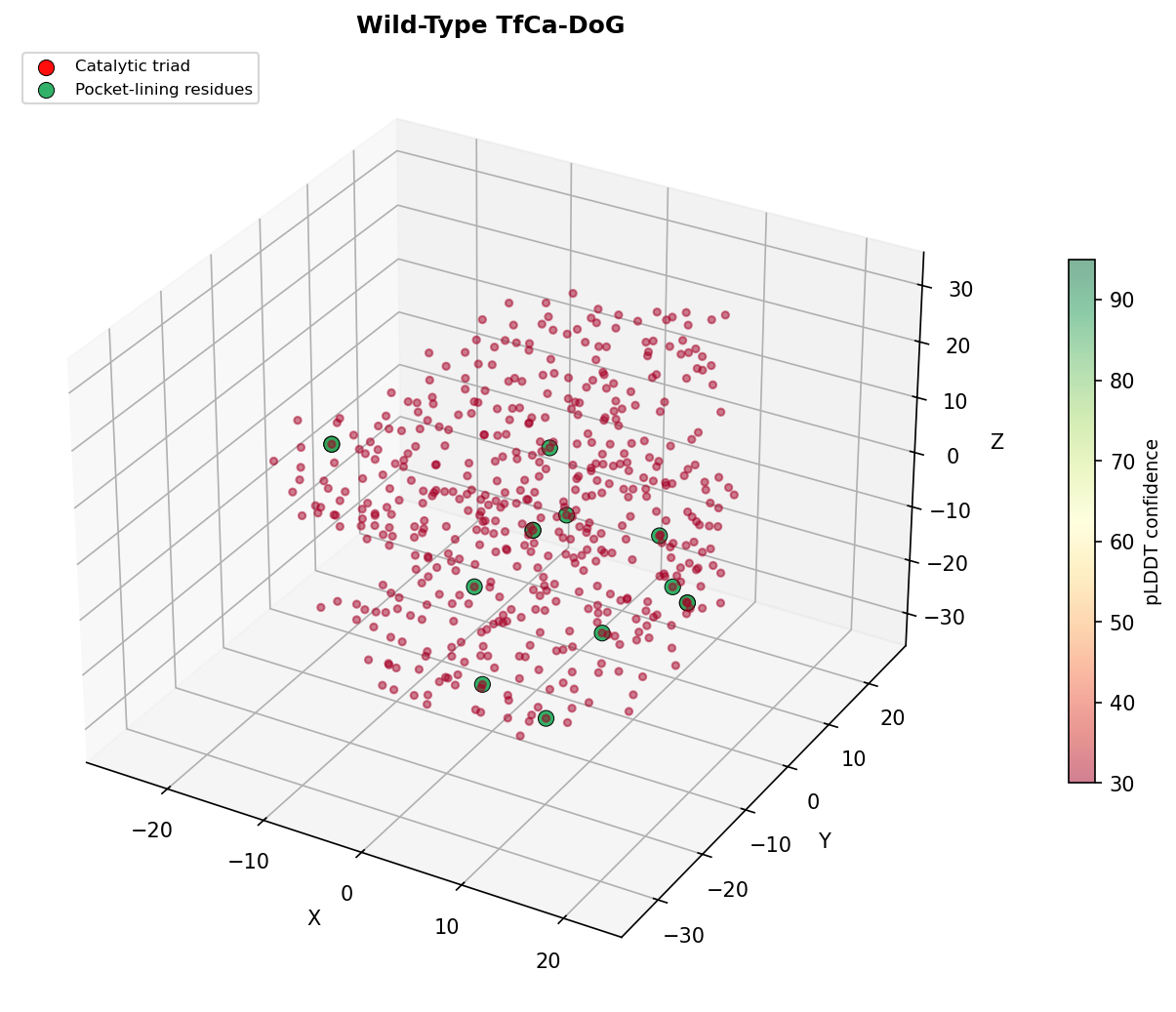
WT MHETase (TfCa–DoG)
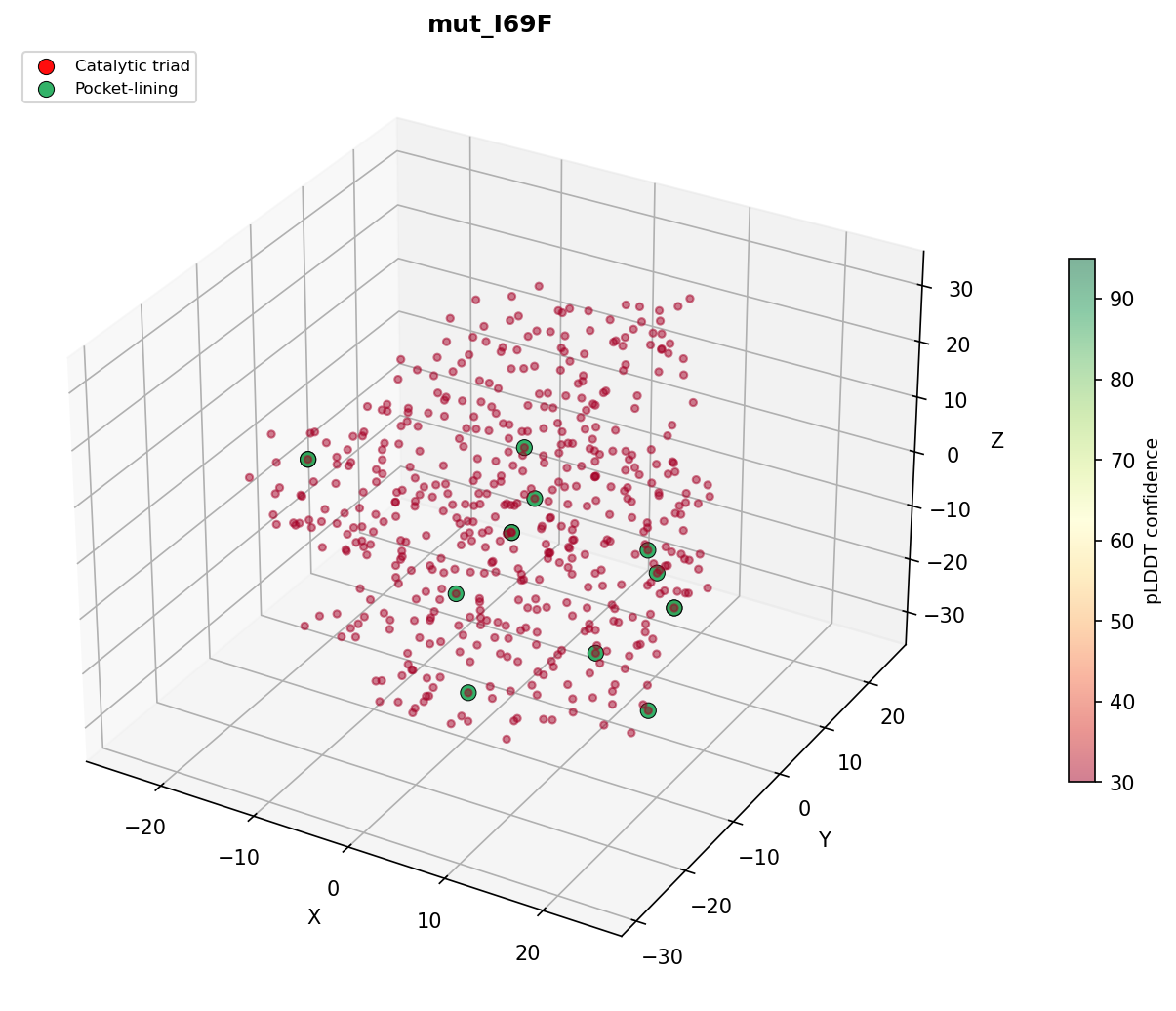
mut_I69F (AI-suggested)
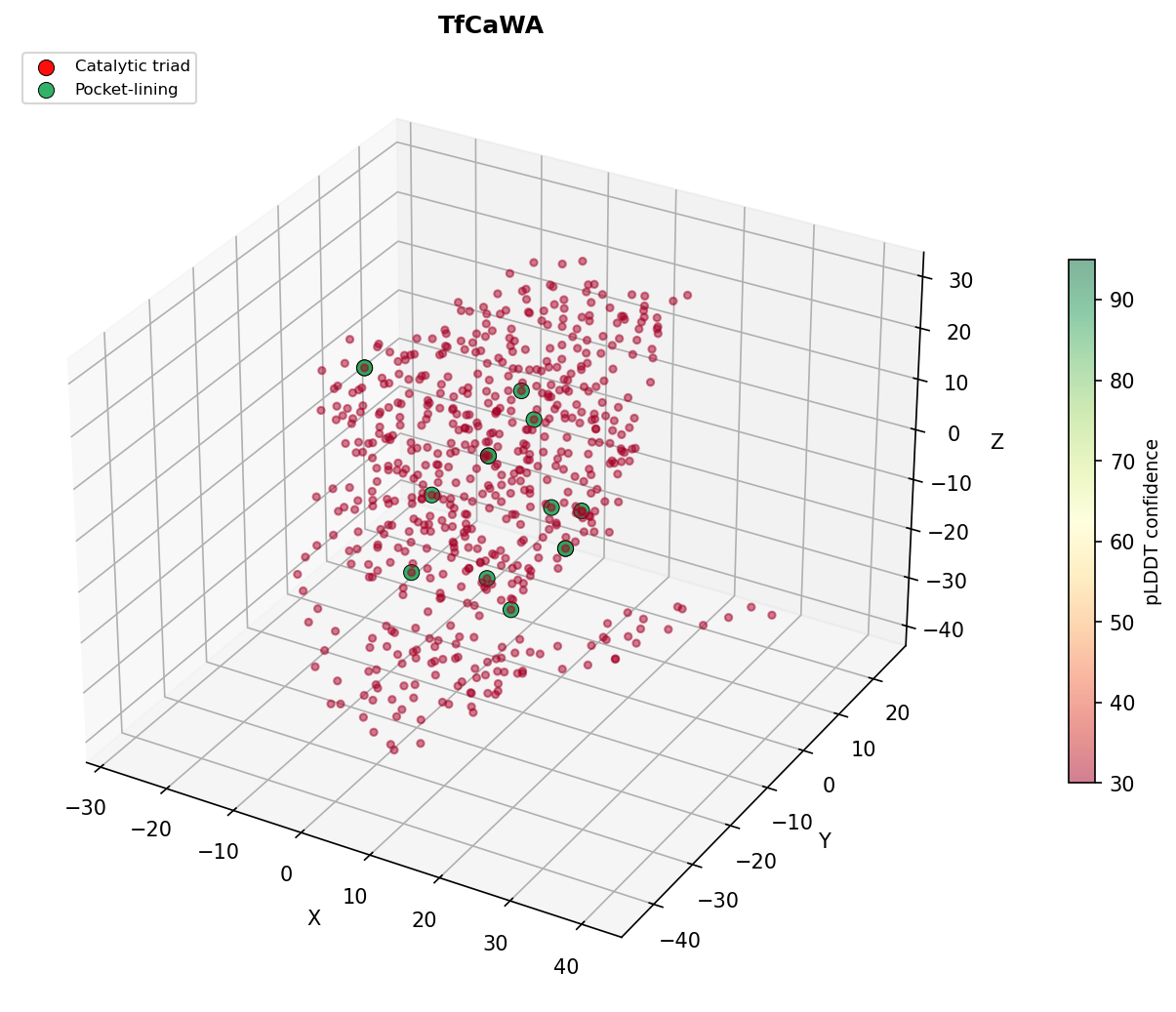
TfCaWA (our rational design, I69W/V376A)
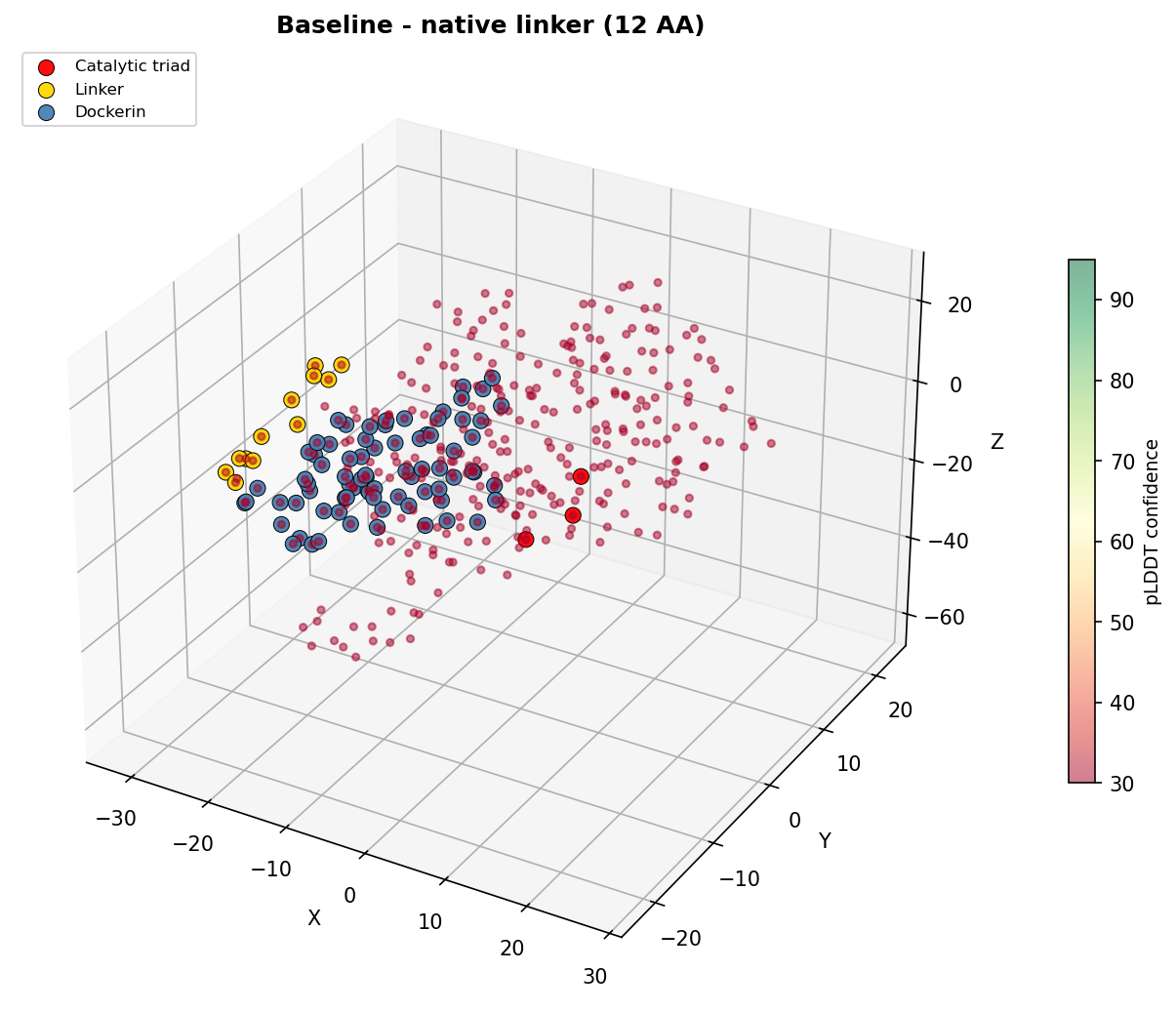
Baseline structure comparison
The I69F preference is still a testable hypothesis worth pursuing — it's independently consistent with our own rational design — but we're not treating the composite ranking as evidence either way until pocket_free_volume() is fixed to account for side-chain identity and the two hardcoded control scores are replaced with real ESM2 output. We plan to synthesize and test I69F and I69F/V376A side-by-side with TfCaWA regardless, in the BHET kinetics assay. Full rankings on Raw Data.
Full executed notebooks & reports
The complete, executed analysis — every cell, figure, and intermediate table — is embedded below, along with the plain-language explainer and the verification report that surfaced the ranking issues described above.
Verification report · confirms the run is genuine model output and diagnoses the two ranking issues above
Full explainer · plain-language walkthrough of the biology, the tools, and what to do next
01_linker_optimization.ipynb · Linker design report
02_mhetase_optimization.ipynb · MHETase engineering report